
Local SEO for Contractors
Local SEO for Contractors: What Actually Gets You Found in 2026
Local SEO for contractors in 2026 means Google, Apple Maps, Bing Places, and AI search. Here's what actually gets remodelers found, in plain English.
By Shelby DuBois · Updated
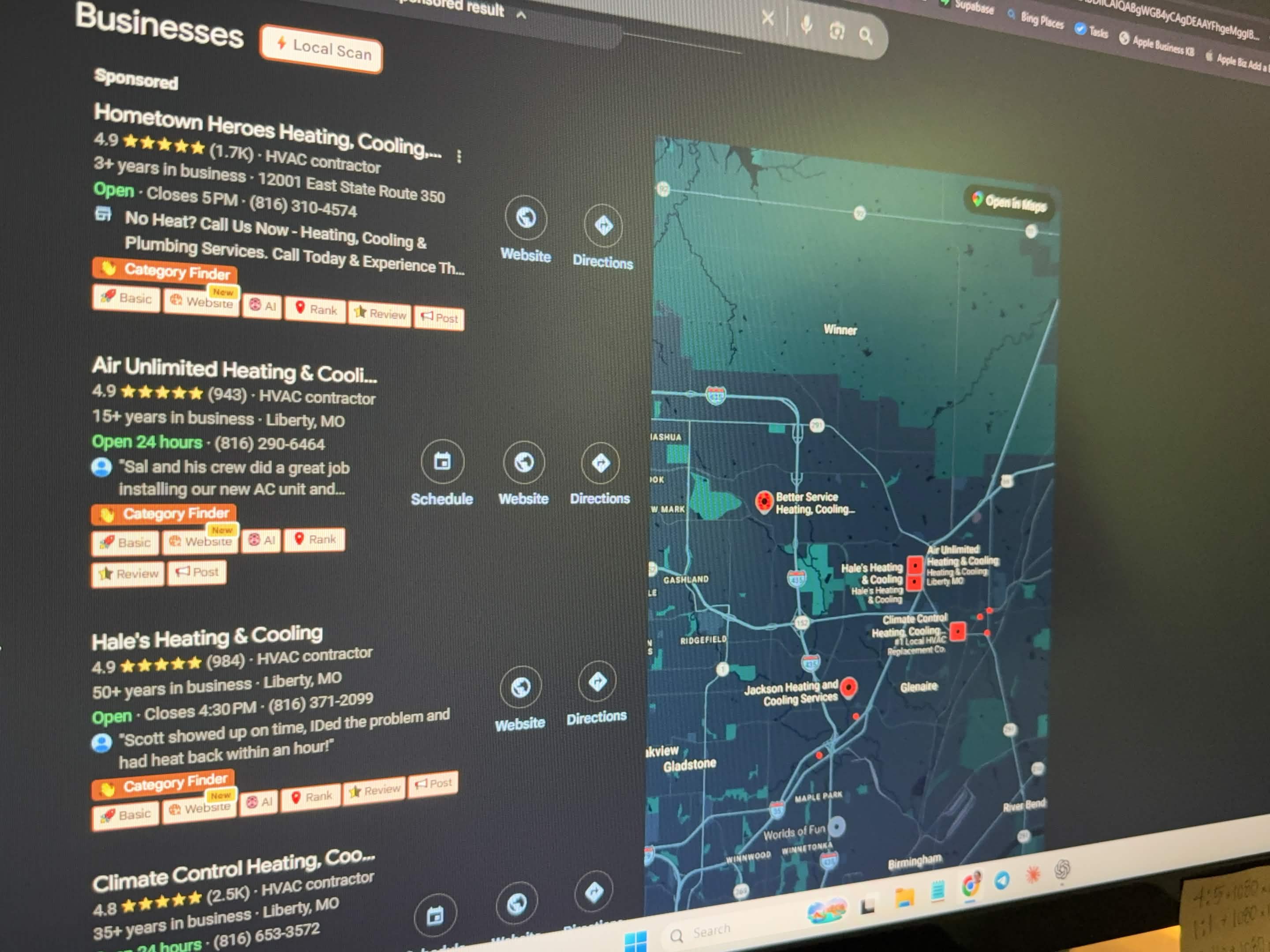
You do things right. Your work speaks for itself, your referrals prove it, and your trucks are booked out. So why does a mediocre competitor show up first when someone searches "remodeler near me"?
Because search doesn't rank craftsmanship. It ranks signals. And most contractors are sending weak ones without knowing it.
Local SEO is just the work of making sure that when someone in your service area searches for what you do, you're the answer they get. Not page two. Not "maybe them?" The answer. In 2026 that means showing up in four places, and most contractors are only working on one of them.
Where your customers are actually searching now
Ten years ago, local search meant Google. Today it's four surfaces:
Google. Still the biggest by far. The map pack (those three businesses with the map at the top) is where most of the clicks go for "near me" searches.
Apple Maps. Every iPhone defaults to Apple Maps, and when someone asks Siri for a "kitchen remodeler near me," Siri pulls from Apple's business listings, not Google's. High-end remodeling clients skew heavily toward iPhones. If you've never claimed your Apple Business Connect listing, you're invisible to a chunk of your best prospects.
Bing Places. Bing sounds like a punchline until you remember it's baked into every Windows computer, and Microsoft's data also feeds AI tools. It takes about 20 minutes to claim and sync your listing. Almost none of your competitors have bothered.
AI search. People now ask ChatGPT and Google's AI Overviews things like "who's a good custom cabinet builder in the Northland?" Those tools build their answers from what's published about you across the web: your site, your listings, your reviews. If that information is thin or contradicts itself, AI either skips you or gets your details wrong.
The good news: the same foundation feeds all four. Get the fundamentals right and every surface picks them up.
Fix your NAP before anything else
NAP stands for Name, Address, Phone. It sounds too basic to matter. It's the thing that quietly kills contractor rankings more than anything else.
Here's why. Google, Apple, Bing, and every AI tool cross-check your business info across dozens of sites: your website, your Google Business Profile, Yelp, Facebook, the BBB, old directories you forgot exist. When the details match everywhere, they trust you're a real, established business. When your old phone number lives on three directories and your new one lives on two others, that trust drops, and so do you.
Contractors are especially prone to this because businesses evolve. You moved shops. You changed numbers. You dropped a service line. Every one of those changes left stale copies of your info scattered across the internet.
The fix is unglamorous: pick the one correct version of your name, address, phone, and hours, then hunt down every listing and make them match. It's tedious. It's also one of the highest-return afternoons you'll ever spend on marketing.
Your Google Business Profile is your real homepage
For local searches, more people see your Google Business Profile than your website. Treat it that way.
A profile that ranks and converts has all of this filled in: every service you offer listed individually (not "remodeling" but "kitchen remodeling," "custom cabinetry," "basement finishing"), accurate categories, real photos of real jobs uploaded regularly, your service area defined, and hours that are actually current.
Photos deserve a special mention for contractors. Your before-and-afters are the single most persuasive asset you own, and most contractors leave them trapped in a phone camera roll. Upload them. Google rewards active profiles, and homeowners hire the contractor whose work they can see.
Then there's reviews. Quantity matters, recency matters more, and responses matter most. A profile where the owner replies to every review, good and bad, reads as a business that shows up. That's exactly the impression a homeowner wants before handing you a six-figure remodel.
Your website still has a job to do
Listings get you found. Your website closes the deal, and it feeds the search engines the details listings can't hold.
Three things matter most for contractors:
Speed. Homeowners research contractors on their phones, often standing in the kitchen they want to gut. A slow site loses them before it loads. Our performance target is 98+ on mobile Lighthouse. Two September 8, 2026 tests scored 97 for Valor Business & Tax Services and 98 for Supreme Property Care, both with a 0.9-second First Contentful Paint. These are individual lab results; scores vary by page and test conditions.
Service pages. One page per service, written for the customer, naming the areas you serve. A single "Services" page listing everything you do gives Google almost nothing to rank. A dedicated custom cabinetry page can rank for custom cabinetry searches. That's the whole trick.
Proof. Project galleries, named neighborhoods, real testimonials. This is also what AI tools quote when they describe your business. Give them good material.
What "AI search visibility" means in practice
This part is newer, so here's the plain version.
When someone asks an AI assistant to recommend a contractor, the AI doesn't rank pages the way Google does. It synthesizes an answer from everything it can find about you. That means it rewards businesses whose story is consistent and specific everywhere: same name, same services, same service area, same phone, backed by reviews and real published detail.
You can test this yourself right now. Open ChatGPT and ask it to recommend your trade in your city. Then ask it what it knows about your company specifically. If it doesn't mention you, or gets your details wrong, that's your baseline, and it's fixable through everything above: clean NAP, complete listings on all three map platforms, a fast site with specific service pages, and steady reviews.
The contractors who fix this in 2026 get a head start that compounds. AI tools tend to keep recommending the businesses they already know.
The 30-minute self-audit
Before you spend a dollar, check where you stand:
- 01
Google your business name
Is your profile complete, current, and full of photos?
- 02
Open Apple Maps and search for your company
Claimed and accurate, or a bare pin?
- 03
Search Bing for your business
Same question.
- 04
Search your old phone number in quotes
Every result showing it's a listing that needs fixing.
- 05
Ask ChatGPT what it knows about your company
Write down what it gets wrong. If you passed all five, you're ahead of most of your market. If you didn't, you now know exactly what's costing you calls.
Where to start
Start by finding the issues that materially affect qualified search visibility and leads. That may mean correcting business information, indexing, tracking, technical SEO or conversion paths. The work depends on the account, access and authorization.
Our Cleanup is a one-time $500 engagement: a full diagnostic, a prioritized cleanup plan, safe corrections and a written before-and-after, followed by verification. Business-information and citation changes happen where authorized. We prioritize the issues that matter rather than promising to change every page, platform or listing.
If your work is better than your search results, fix the search results. Get the Cleanup or call us and we'll tell you honestly whether you even need it.
The answer desk
Article FAQs
Short answers for contractors comparing website options.
What is local SEO for contractors?
Local SEO for contractors is the work that helps customers in your service area find and trust your business across Google, map listings, your website, reviews, directories, and AI search tools.
Should contractors claim Apple Maps and Bing Places too?
Yes. Google is still the biggest local search surface, but Apple Maps powers Siri and iPhone defaults, while Bing Places feeds Microsoft search surfaces and can support AI visibility.
What should contractors fix first?
Start with NAP consistency: the same business name, address, phone number, and hours everywhere. Then clean up Google Business Profile, Apple Maps, Bing Places, service pages, photos, and reviews.
Does a contractor website still matter for local SEO?
Yes. Listings help you get found, but the website gives search engines and buyers the service detail, proof, project examples, service-area context, and calls to action that listings can't hold.
How does AI search change local SEO?
AI search pulls from information published across the web. Contractors with consistent listings, specific service pages, recent reviews, and real proof give AI tools better material to understand and recommend them accurately.
Ready to Stop Chasing Leads?
Let's build a system that brings qualified jobs to you. No nonsense, no inflated promises, just strategic execution.
Like what you're reading? Add us as a preferred source on Google.